


What Is the Best Fertilizer for Cannabis Plants?
If you’ve ever searched for the “best fertilizer for cannabis,” you’ve probably found two extremes: (1) confident one-brand answers, and (2) endless forum debates. The truth is more nuanced—and more useful: there isn’t one universal “best” fertilizer for every cannabis plant.
The “best” option is the one that fits your growing approach, is transparent about what’s inside, and helps you maintain consistent plant nutrition without guesswork or hype. Below is a practical, evidence-informed way to think about it— plus what growers repeatedly argue about online (and why).
For more educational reads from our team, visit the Montreal Cannabis Seeds Blog.
Quick Answer: There’s No Single “Best”—Here’s the Best Way to Choose
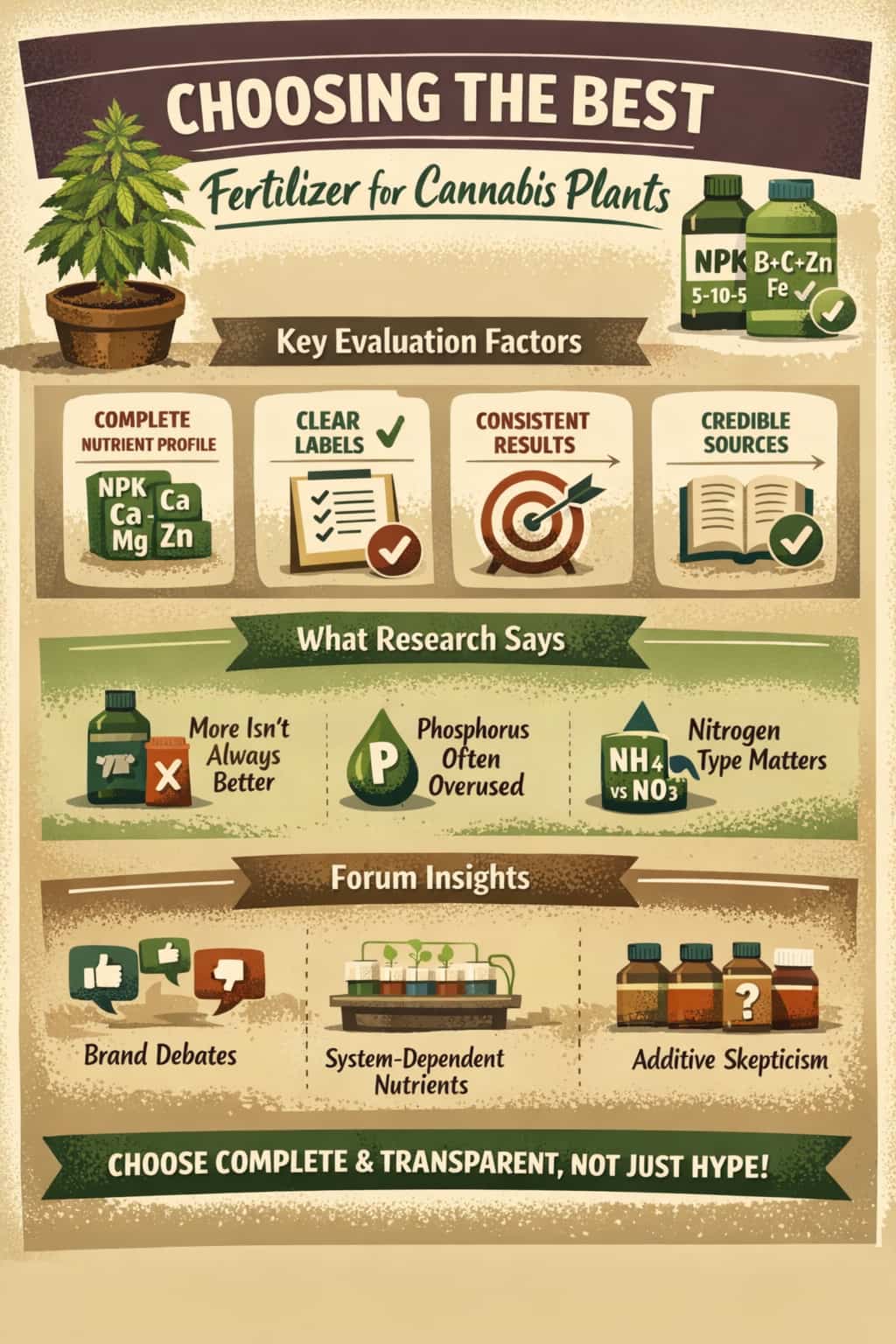
Research on cannabis nutrition has expanded in recent years, and one consistent theme is that plant response depends on cultivar, environment, and production system—so the “best” fertilizer is rarely a single product for everyone. Instead of chasing a universal winner, evaluate fertilizers using these criteria:
- Completeness: clear macronutrients and a full micronutrient profile (not just “magic additives”).
- Transparency: a clear guaranteed analysis and straightforward labeling.
- Consistency: predictable results run-to-run (important for repeatability and troubleshooting).
- Support: credible documentation (not just influencer claims).
- Fit: aligns with your cultivation style and your local legal requirements.
What Reliable Research Says (Without the Hype)
When people talk about “best fertilizer,” they often mean “what maximizes yield or quality.” Controlled studies can’t crown one brand as best, but they do show patterns that help you avoid common mistakes.
1) “More” isn’t automatically better
Multiple peer-reviewed studies show that plant performance often follows a curve: too little nutrition is limiting, but excessive fertilization can reduce performance or efficiency (and increase waste). For example, research on cannabis and hemp has reported diminishing returns at higher fertilizer rates and, in some cases, reduced growth or changes in chemical composition at higher feeding levels.
2) Phosphorus is frequently over-emphasized in marketing
A recurring finding in controlled work is that pushing phosphorus beyond reasonable levels may not improve flower yield or cannabinoid concentration, while it can increase phosphorus losses in runoff/leachate—an efficiency and sustainability issue.
3) Nitrogen form can matter (not just the number on the label)
Cannabis studies have also highlighted that the form of nitrogen can influence plant performance and chemistry. This is one reason why two fertilizers with “similar N” can perform differently, especially across different production systems.
If you like reading the primary literature, see the references section at the end for peer-reviewed sources.
What Grow Forums Reveal (And What They Don’t)
You asked specifically to include insights from cannabis forums. Forums are valuable for spotting patterns of real-world problems, but they are not controlled experiments. The same threads that contain genuinely helpful observations also contain contradictory claims and strong brand loyalty.
Common themes that show up repeatedly
- Brand debates: “best” often means “best in my setup,” not universally best.
- System-dependence: growers frequently say the right nutrients depend on their medium and approach.
- Additive skepticism: many growers question whether large stacks of supplements provide measurable benefits.
- Conflicting advice: even experienced growers disagree—proof that context matters.
Good practice: use forums to discover what people struggle with (and what questions to ask), then validate decisions using transparent product labeling and reputable references.
How to Evaluate Any Cannabis Fertilizer (A Buyer’s Checklist)
Here’s a practical way to compare fertilizers without relying on hearsay or “secret sauce” marketing. This is a product-evaluation checklist—not a cultivation recipe.
1) Look for a clear guaranteed analysis
The label should clearly describe what’s inside and in what proportions. Vague claims like “premium bloom enhancers” are not a substitute for transparency.
2) Confirm micronutrients are included (or clearly supported)
Many feeding issues blamed on “bad genetics” or “bad lights” are actually nutrition gaps or imbalances. A quality fertilizer approach is explicit about micronutrients and how the product is intended to be used.
3) Prefer programs that emphasize repeatability
The easiest way to improve results over time is to run a system that is consistent and easy to troubleshoot. If the plan depends on dozens of optional bottles, it can be harder to pinpoint what’s helping (or hurting).
4) Check for credible documentation
Trust products that provide straightforward technical documentation and safety information—not just testimonials.
Where This Fits in Your Bigger Growing Knowledge
Fertilizer is only one piece of the puzzle. If you’re building a complete knowledge hub for customers, these internal reads fit naturally alongside nutrition-related topics:
- Feminized vs. Regular vs. Autoflowering Marijuana Seeds — helpful context for readers choosing genetics.
- How Feminized Cannabis Seeds Are Made — a deeper educational piece that supports trust and authority.
- The Definitive Guide to Keeping Your Cannabis Seeds Fresh — a strong companion article for seed customers.
- The Untold History of 420 — a culture/industry piece that keeps readers engaged on-site.
FAQ: Best Fertilizer for Cannabis Plants
Is there a single best fertilizer brand?
Not in a way that reliable research can prove for all environments and cultivars. “Best” is typically system-dependent, which is why forum answers vary so much.
Why do forum recommendations conflict?
Because growers have different media, water, environments, and goals—and forum posts are personal reports, not controlled comparisons. They’re useful for spotting common issues, but not definitive proof.
What’s the most research-backed takeaway?
Controlled studies suggest that plant response often has an optimum zone and that excessive fertilization—especially overemphasis on certain nutrients— may not deliver benefits while increasing inefficiency and waste.
References & Further Reading
Peer-reviewed / academic sources
- Sustainable Cannabis Nutrition (2022, PubMed Central) — examines effects of increasing phosphorus on yield/chemistry and leachate.
- High NH4/NO3 Ratio Reduces Cannabinoids, Terpenoids (2022, PubMed Central) — shows nitrogen form can materially affect plant outcomes.
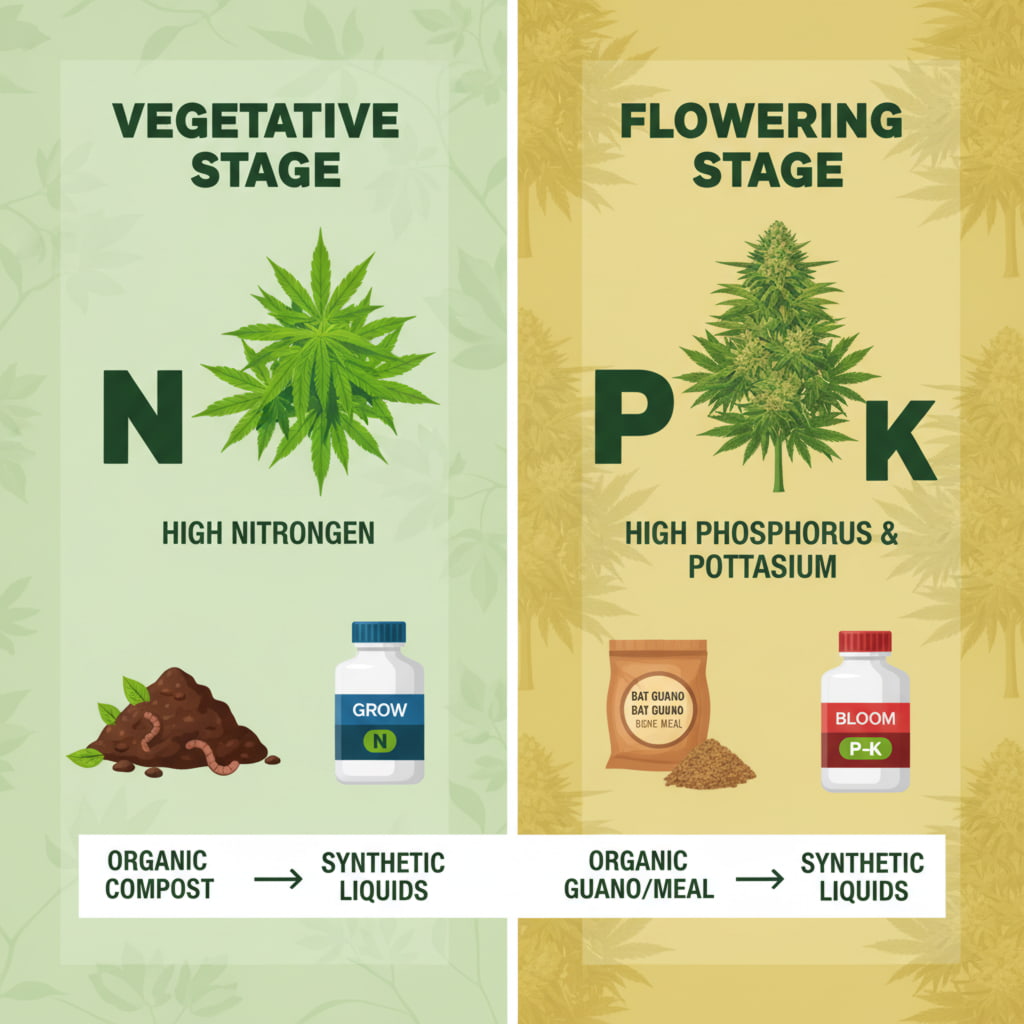
- Optimisation of N, P, and K for Soilless Cannabis in Flowering (2021, Frontiers) — demonstrates system-dependent nutrient optimization and non-linear responses.
- Organic Fertilizer Rate During Flowering Stage (2017, HortScience) — reports relationships between fertilization rate and chemical outcomes.
- Mineral Nutrition for Cannabis in Vegetative Stage (2024, Frontiers) — explores mineral requirements during vegetative growth in controlled settings.